

Capital Markets | Capital Expenditure | New Trends | Capital Expenditure - 2021
Exxon Unveils New 'Low Carbon' Business Unit; Reaffirms 2021 Capex
 Print
|
Print
|

ExxonMobil has reaffirmed its 2021 capex and outlined its plans through 2025.
The company also outlined its strategy to commercialize lower emission technologies in support of the goals of the Paris Agreement.
Reaffirms 2021 Capex of $16-19B
Exxon reaffirmed its plan to spend $16-19 billion in 2021.
In the years that follow 2021, Exxon has estimated it will spend $20-$25 billion per year through 2025 on high-return, cash-accretive projects.
CEO Darren Woods said: "Our investments are expected to generate returns of greater than 30 percent. And 90 percent of our upstream investments in resource additions, including in Guyana, Brazil and the U.S. Permian Basin, generate a 10 percent return at $35 per barrel or less. Downstream investments improve net cash margin by 30 percent and our Chemical investments grow high-value performance products by 60 percent."
New Low Carbon Business Unit
To grow shareholder value through the transition to a lower carbon economy, ExxonMobil has focused its extensive research and development portfolio on technologies to address hard to de-carbonize sectors of the economy.
The company's newly created business, ExxonMobil Low Carbon Solutions, was established to commercialize low-emission technologies, and will initially focus on carbon capture and storage (CCS), the process of capturing CO2 that would otherwise be released into the atmosphere from industrial activity, and injecting it into deep geologic formations for safe, secure and permanent storage.
The plans are expected to reduce absolute greenhouse gas emissions by an estimated 30 percent for the Upstream business. Absolute flaring and methane emissions are expected to decrease by 40 to 50 percent under the plans. The company also aims for industry-leading greenhouse gas performance and to eliminate routine flaring in line with the World Bank initiative by 2030.
Woods commented: "We are fully committed to growing shareholder value by meeting the world's energy demands today and pursuing a technology-driven strategy to succeed through the energy transition.
"Our investment portfolio is the best we've had in over 20 years, and will grow earnings and cash flow in the near term while remaining flexible to market conditions and benefiting from ongoing cost-reduction efforts. Looking ahead, we're working to reduce our emissions and develop solutions, such as carbon capture and low-carbon hydrogen, needed to de-carbonize the highest emitting sectors of the economy - a critical requirement for society to achieve its net zero ambition."
CCS Technology Outline
ExxonMobil is the industry leader in CCS technology and has more than 30 years of experience capturing carbon. The company has an equity share in about one-fifth of global CO2 capture capacity and has captured approximately 40 percent of all the captured anthropogenic CO2 in the world. ExxonMobil also produces about 1.3 million tonnes of hydrogen per year and is developing technology that could significantly lower the cost of both CCS and low-carbon hydrogen.
The International Energy Agency projects that CCS could mitigate up to 15 percent of global emissions by 2040 and the authoritative U.N. Intergovernmental Panel on Climate Change (IPCC) estimates that global de-carbonization efforts could be twice as costly without CCS.
Using estimates and demand projections, including from IPCC Lower 2 degree Celsius scenarios, the market for CCS and other low-emission technologies and products is expected to grow significantly by 2040.
"Our development of next-generation technologies and existing businesses positions us well to capitalize on the growing demand for de-carbonization and market opportunities that are increasingly coming together to support lower-carbon energy solutions," said Woods.
ExxonMobil met its 2020 emission reduction goals that included 15 percent reduction in methane emissions versus 2016 levels, and a 25 percent reduction in flaring versus 2016 levels.
The company's 2025 emission reduction plans include a 15 to 20 percent reduction in upstream greenhouse gas intensity versus 2016 levels, supported by a 40 to 50 percent reduction in methane intensity and 35 to 45 percent reduction in flaring intensity.
More Alt Energy-Renewable News

Razor Energy Corp. Second Quarter 2021 Results
Razor Energy Corp. reported its Q2 2021 results. Highlights: Acquisition On August 12, 2021, the Company completed an agreement to acquire certain non-operated working interest assets in its…

Antero Resources Second Quarter 2021 Results
Antero Resources Corp. reported its Q2 2021 results. Q2 Highlights Include: Net production averaged 3,324 MMcfe/d, including 173,000 Bbl/d of liquids Realized natural gas equivalent price averaged $3.78…

Talos, Storegga Partner for Carbon Capture Storage Project in GOM
Talos Energy Inc. has formed an exclusive joint venture with Storegga Geotechnologies Ltd. to source, evaluate and develop carbon capture and storage (CCS) project. The JV will evaluate…

Razor Energy Corp. First Quarter 2021 Results
Razor Energy Corp. reported its Q1 2021 results. Q1 2021 Highlights: Financing: The Company renewed the Amended Term Facility with AIMCo (the “AIMCo Term Loan”) on February 16,…

Talos Details ESG Initiatives; Looks to Cut Emissions 30% by 2025
Talos Energy Inc. provided an update on its ongoing Environmental, Social and Governance (ESG) initiatives. Corporate Updates: Established target of 30% reduction in greenhouse gas (GHG) emissions intensity…
Mid-Continent News

Why $90 Oil Isn’t Bringing Back the Rigs
Higher oil prices are not translating cleanly into a drilling response across U.S. shale, and company disclosures are starting to show why. The issue is not simply capital…

These Three Companies Will Increase Drilling & Completion Over The Next 3 Year
In the span of fifteen months, three Japanese energy companies committed more than $10.3 billion to U.S. natural gas production assets — a buying spree that has transferred…

Q1 A&D Transactions Jump to $30B , While Deal Flow Was Down 40%
The first quarter of 2026 has officially defined the "Barbell Era" of American oil and gas. While the total number of deals plummeted by 46% YoY (dropping to…

Wright to U.S. Oil Industry: The Price Signal Is Telling You to Drill
Energy Secretary Chris Wright stood in front of the largest gathering of oil executives in the world this morning and delivered a message that was equal parts market…

Apa Corp : Doing More With Less
APA's 2025 narrative was one of operational surprise. The company came in beating production guidance every single quarter while spending below plan, capturing over $300MM in cost savings…
Mid-Continent - Arkoma Basin News
Permian Resources to Grow Production 6% in 2026
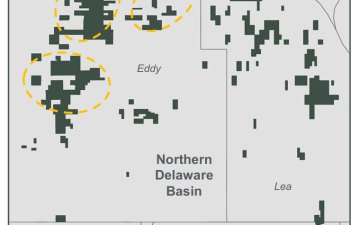
Permian Resources exited 2025 as the largest pure-play Delaware Basin operator with ~480,000 net acres and >105,000 net royalty acres. The company averaged 392.6 MBoe/d in 2025, including…

Battalion Oil Closes ~$60M West Quito Draw Asset Sale
Battalion Oil Corporation has closed the sale of its West Quito Draw assets in the Southern Delaware Basin to MCM Delaware Resources LLC, a subsidiary of MCM Energy…

Deal Rumor: ConocoPhillips Exploring $2B Permian Asset Sale
ConocoPhillips is reportedly exploring the potential sale of certain Permian Basin assets in a transaction valued at approximately $2 billion, according to Reuters, citing sources familiar with the…

This Operator Will Chop it's 2026 Rig Count From 34 to 24
ConocoPhillips is setting up 2026 as a lower-intensity, more efficient operating year — with the clearest proof coming from the Lower 48 activity reset following the Marathon integration.…

A Quiet Capital Pattern Is Forming in North American Upstream — and Almost No One Is Talking About It
A handful of recent transactions and capital raises point to a subtle pattern in North American upstream—one that is easy to miss because each event, on its own,…